
Find Walla Walla Residents
Begin with the record that matches what you know. An address belongs first in the Walla Walla County Assessor and Treasurer Property Search. A person's name may fit the Auditor's recorded-document index, the Washington court search, or a historical directory. A family-history question may call for Whitman College and Northwest Archives, the Walla Walla Public Library, or Fort Walla Walla Museum. These are separate rolls, not one master list. Each was created for tax, title, voting, court, or archival work, so its result proves only what that record says.
The Walla Walla residents directory works best as a chain of checks. Owners appear more often than occupants in parcel and deed data. VoteWA lets a voter check their own registration, while access to the statewide voter extract is governed by Washington law. A printed directory can place a listed householder at an address in a given year, but it can omit people and cannot establish who lives there now.
- Enter the address in the county property search and record the parcel number, owner field, and tax area.
- Use VoteWA for your own registration, or follow the statutory voter-file request process for an authorized public-record purpose.
- Search EagleWeb by grantor, grantee, date, reception number, or document type to locate recorded instruments.
- For an older household, ask the local archives which city-directory or telephone-book years cover the address.
- When an agency record is not online, inspect it at the office or make a focused Washington Public Records Act request.
Walla Walla Directory Offices
Walla Walla is the county seat, which keeps the main county custodians close together. The Auditor's Recording Department maintains deeds and other recorded instruments. The Assessor and Treasurer connect parcels with appraisal and tax data. County Elections administers voter records under state law, and the County Clerk holds Superior Court files. City departments separately keep permits, police disclosures, GIS layers, and cemetery records. For the full address-first method, use the Walla Walla street directory.
Walla Walla County Auditor
315 W Main Street
Walla Walla, WA 99362
509-524-2549
Walla Walla County Assessor
315 W Main Street
Walla Walla, WA 99362
509-524-2560
Walla Walla County Elections
315 W Main Street, Room 203
Walla Walla, WA 99362
509-524-2530
Search Walla Walla PropertyAccess
The county's PropertyAccess portal is the strongest current address tool in the Walla Walla residents directory. It supports parcel, street, DBA, sales, legal-description, and tax-year searches. Official exports contain an Owner Name column, though the static search screen captured for this project did not show a direct owner-name box. Check the Search Type menu or call the Assessor rather than assuming the field is gone.
| Search control | Use in Walla Walla | Practical limit |
|---|---|---|
| Property ID or parcel | Opens one known tax parcel | Requires an exact identifier |
| Street | Finds parcels by address terms | Shows ownership, not every occupant |
| Sales | Filters transfer activity | Confirm title in EagleWeb |
| Legal description | Bridges plats, blocks, and lots | Read the recorded image for certainty |
| Tax year | Separates assessment periods | Does not create a residence history |
The screenshot below shows the range of controls available on the official portal. It helps explain why an address search and a deed search answer different questions.
Open Walla Walla County PropertyAccess before comparing the captured interface.
The parcel, street, sales, and legal-description choices provide a clear starting point, while EagleWeb supplies the recorded-instrument side of the chain.
Read Walla Walla EagleWeb
The Auditor's EagleWeb index covers scanned recorded documents from January 1, 1951 forward. Search by grantor, the party giving an interest, or grantee, the party receiving it. Reception number, date range, document type, subdivision, block, and lot provide other paths. The index is regularly updated, yet it is not the complete historical courthouse. Some veteran records are index-only, poor historic images may be omitted, and official copies still come from the Auditor.
- Index
- A finding tool that points to a recorded document.
- Parcel
- A mapped unit of land with its own county identifier.
- Criss-cross directory
- A directory arranged by street or telephone number instead of only by surname.
- Reception number
- The unique number assigned when an instrument is recorded.
For a pre-1951 lead, contact the Auditor, then use the Eastern Washington Regional Archives, the State Archives, historical directories, and maps. An online miss is not proof that no deed exists.
Review EagleWeb's official search help to see its name and subdivision rules.
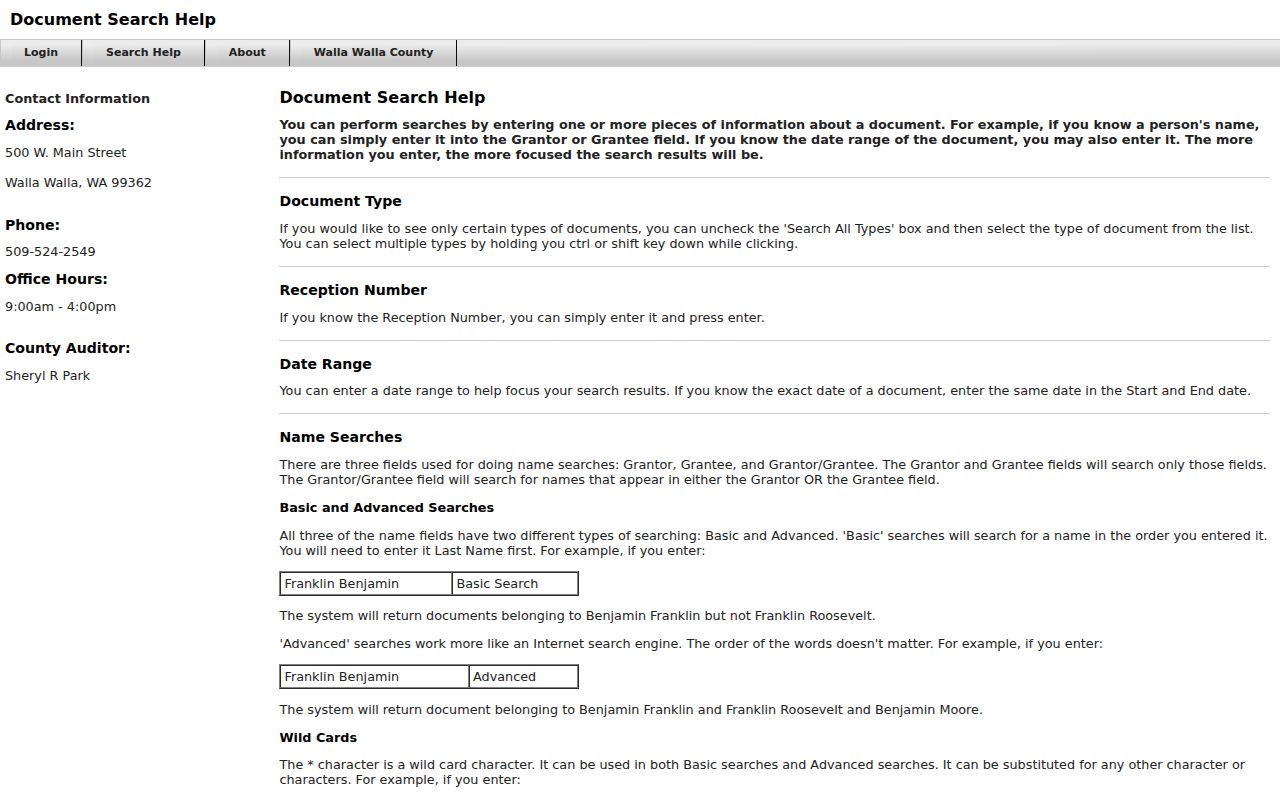
The help screen documents surname-first searches, wildcard symbols, date fields, and lot-range syntax that make the Walla Walla directory trail more precise.
Current Walla Walla Directory Sources
No current roll lists all Walla Walla residents. Choose a source by the relationship it records. PropertyAccess identifies parcels and displayed owners. EagleWeb indexes people and entities named on recorded instruments. Court portals identify parties in public case indexes, subject to restricted categories. VoteWA is a personal registration check, while a voter-database extract requires the state request process and remains subject to use limits.
| Source | Who It Lists | Keeper | Access |
|---|---|---|---|
| PropertyAccess | Displayed parcel owners | County Assessor and Treasurer | Free web portal |
| VoteWA / voter extract | Registered voters within legal limits | County Elections and Secretary of State | Self lookup or formal request |
| EagleWeb | Parties to recorded instruments | County Auditor | Free index; official copies from office |
| Odyssey and statewide courts | Parties in public court indexes | Washington courts and County Clerk | Online lead; file request for detail |
| City directories | Historically listed households | Local and state libraries | Reading room or planned request |
The source's purpose controls what a hit means. A deed party may never have occupied the parcel. A directory listing is tied to its publication year. A court index does not prove identity or outcome. For a name-centered comparison, follow the Walla Walla resident lookup workflow.
Verify Walla Walla Court Names
Washington provides a statewide court name search, and Odyssey Portal is the current route for Walla Walla Superior Court cases. The Washington Court Directory identifies the Superior Court, District Court, and County Clerk contacts. Search results are leads. Restricted matters may not appear, masked birth data limits matching, and the index alone does not prove a disposition or even that a common-name hit is the intended person.
The Washington State Digital Archives reports 1,471,165 Walla Walla County Superior Court case-file records for 1926 through 2026. That large title still carries access restrictions. Use a case number, court, filing date, and another identifier before drawing a conclusion. Request the actual public file from the Clerk when the case content matters.
Record check. Treat every name result as unverified until two independent details, such as middle name and historical address, match.
Use Walla Walla Voter Records
VoteWA / MyVote checks a voter's own registration with first name, last name, and date of birth as recorded. It is not a general public people finder. Under RCW 29A.08.710, specified voter fields may be public, including name, address, political jurisdiction, gender, year of birth, voting record, registration date, and registration number. Washington does not register voters by party, and voting history never discloses a ballot choice.
The state voter database extract uses a request form and statutory limits. Protected fields remain out of the public file, and data may not be used for commercial solicitation. The Address Confidentiality Program can substitute an address and protect original records for eligible participants. Never try to undo that protection by matching maps, voter data, or other entries.
Visit the official VoteWA lookup before viewing the captured form.
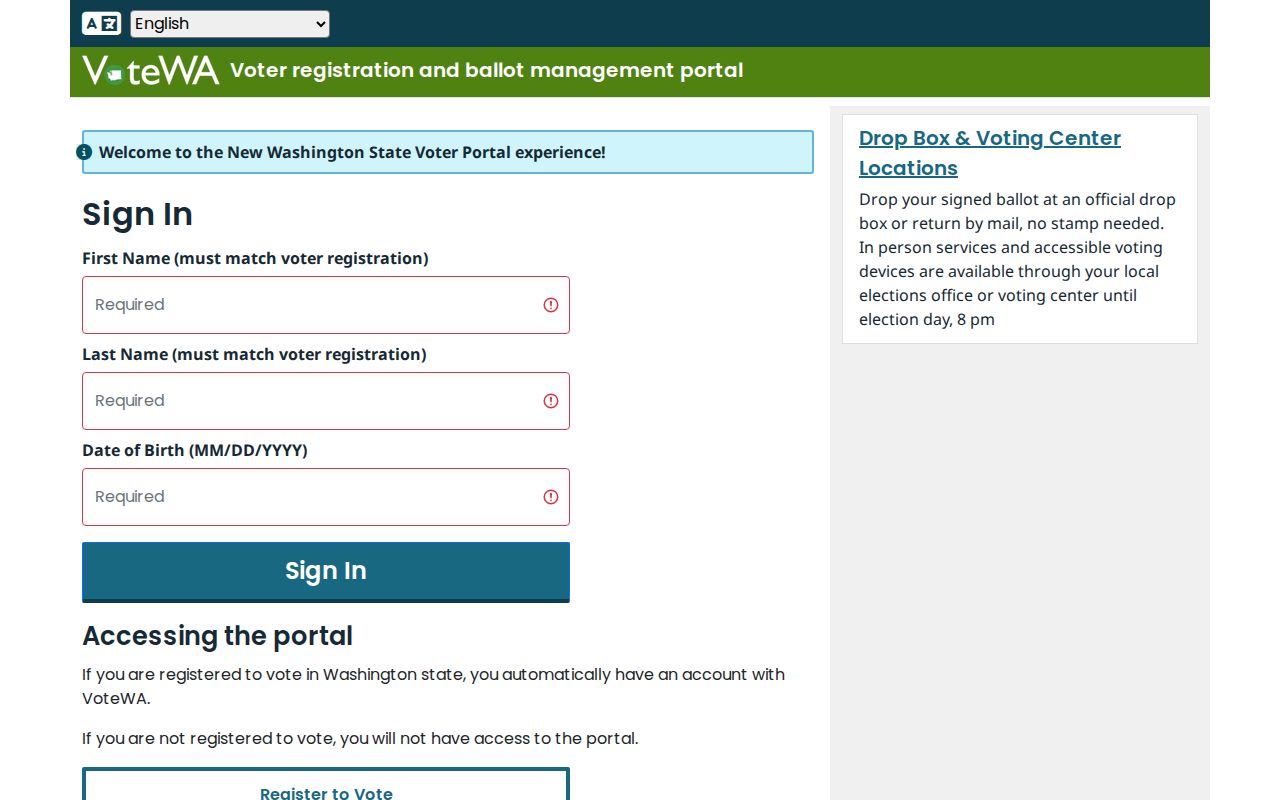
The form's identity fields show why the service is designed for a voter checking their own registration, not an open search of Walla Walla residents.
Request Walla Walla Records
The Washington Public Records Act, chapter 42.56 RCW, supplies a fallback when a city or county record is not posted. An agency must respond within five business days by producing records, giving a reasonable estimate, asking for clarification, or citing a specific exemption. Inspection is free. When default statutory charges apply, paper copies may cost 15 cents per page and scanned pages 10 cents each.
Send a narrow request to the office that created the record. The City of Walla Walla request form asks for a clear description, delivery choice, and required attestation. Police disclosures use the department's separate route. Court files follow court access rules instead of chapter 42.56; the County Clerk's NextRequest notice makes that distinction explicit.
Include a date range, address, permit or parcel number, and known record type. That gives staff a workable search and avoids a broad request that may need clarification.
Trace Walla Walla Family Records
Vital records have their own access rules. Washington Department of Health issues birth, death, marriage, and divorce certificates under chapter 70.58A RCW. Certified birth and death products require a qualified applicant plus identity and eligibility proof. Noncertified informational birth and short-form death copies are public for a fee. Birth records transfer to the State Archives after 100 years; deaths, marriages, and divorces transfer after 25 years.
For events before the statewide cutoff, use the local custodian. The Walla Walla County Auditor handled pre-1968 marriages, while the Superior Court Clerk holds divorce decrees. DOH marriage and divorce certificates cover 1968 forward. A certificate and a decree are not the same item. The State Archives research subjects page also points to historical indexes, probate, naturalization, and census sources.
Mountain View Cemetery adds a useful local index. Its official material describes nearly 80 acres, more than 40,000 interments, and an identified 1854 burial. Pair a burial result with a newspaper notice and an eligible vital record rather than treating it as proof of every family link.
Browse Historic Walla Walla Directories
Historical volumes fill gaps that current portals cannot. The Washington State Library catalogs Walla Walla city-directory years from 1900 through 2000 with gaps, plus county and telephone-directory runs. Whitman College and Northwest Archives holds city directories, Union-Bulletin newspapers on microfilm, yearbooks, and regional collections. The public library's Pacific Northwest Collection and HeritageQuest, and the Fort Walla Walla Museum research library, add more routes.
A directory entry can show a printed name, address, occupation or business line, household notation, and sometimes a street-arranged section. Preserve the year, page, spelling, and abbreviation key. It is evidence that a publisher listed that person then, not a current residence finding. The full shelf and tracing method appear in the Walla Walla city directory page.
Track Walla Walla Access Changes
Several local systems are in motion. City permit records from before August 19, 2025 may require help from Development Services after a software change. The Walla Walla Public Library began work from a temporary location in 2026 during renovation and catalog changes. Confirm its current hours and address before planning archival work.
Boundary work can also alter which office holds a record. The city's active Williams Road and Prospect Avenue annexation file is a proposal, not proof that a parcel has entered the city. Check its effective status against City GIS and county parcel data. Current portal availability, public hours, and project status were researched on September 3, 2026 and should be verified with the custodian.
Lawful use. Use Walla Walla records for legitimate personal and civic research. Never use an address trail to stalk, harass, or harm anyone.