
Walla Walla Directory Runs
The Washington State Library publishes the clearest year-by-year inventory. Its lists preserve gaps, which matter. A missing year means only that the stated collection does not list that volume. It does not prove no directory appeared. Whitman Archives confirms local city directories but asks researchers to check volume-level availability.
| Collection | Years located | Where held | Access |
|---|---|---|---|
| City directories | 1900-05; 1907-18; 1920-26; 1929-33; 1935; 1937; 1939; 1941; 1946; 1948-64; 1966-67; 1969-87; 1989-90; 1997-2000 | Washington State Library inventory; Whitman has local volumes | Verify appointment and exact volume |
| County directories | 1902-05; 1907-18; 1920-26; 1929-33; 1935; 1937; 1939; 1941; 1946; 1948-59; 1961-62 | State Library | Limited appointment access |
| Telephone books | 1940; 1944-51; 1953-55; 1957-59; 1962-65; 1967-86; 1988-2004; 2006-07; 2009-11 | State Library | Verify before travel |
| Local history holdings | Years vary by item | Whitman Archives, public library, museum | Reading room, card, or appointment |
The State Library city and telephone directory inventory is a planning tool, not a digitized Walla Walla shelf. Its notice described closure to general public access from July 1, 2025, with limited Thursday appointments. Confirm current terms before travel.
Check the State Library inventory before viewing its captured page.
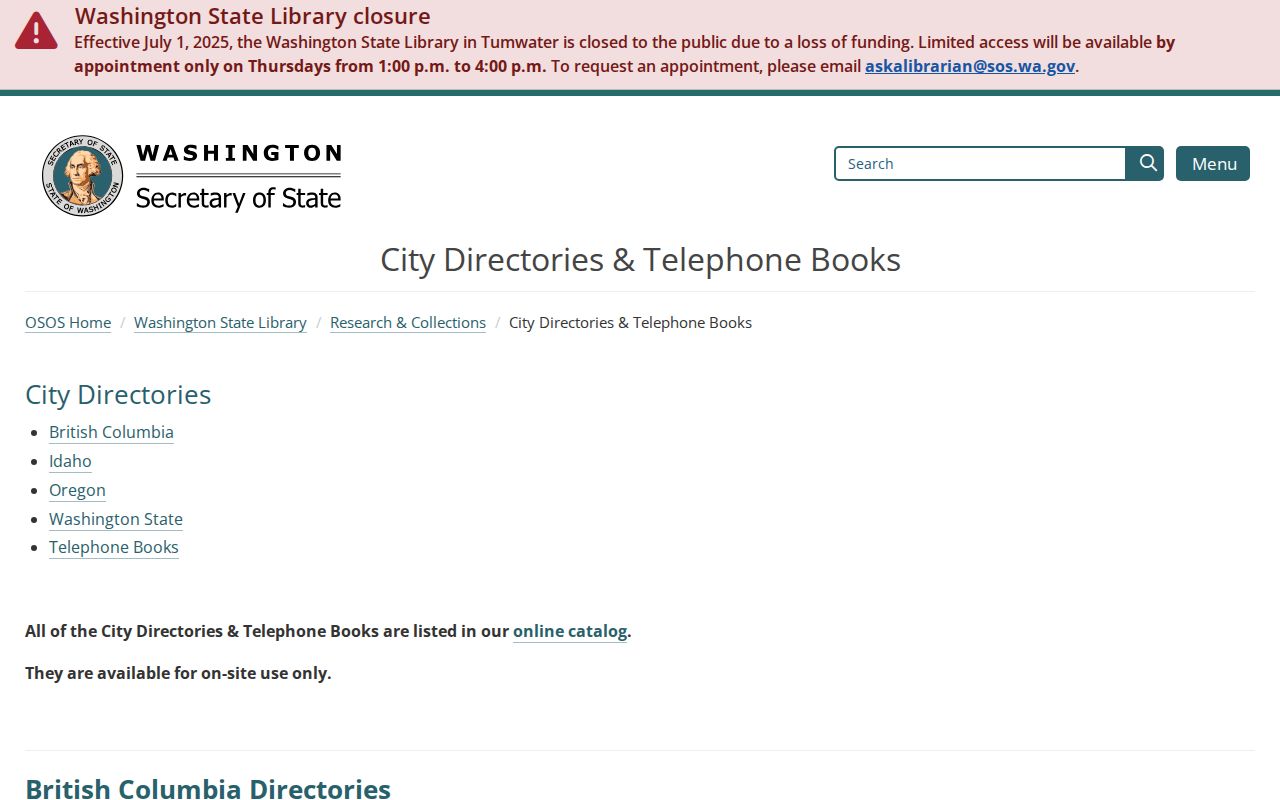
The inventory screen supplies the exact year runs and makes the gaps visible instead of smoothing them into a false continuous span.
Read Walla Walla Directory Entries
A city directory entry can include a name, street address, trade or business, spouse, telephone, or household notation. Symbols vary by publisher. Never carry the meaning of an abbreviation from one volume into another without checking that book's key. Preserve the title page, year, page, exact spelling, unit, cross-reference, and whether the item is a person, firm, institution, or “see” entry.
| Name | As printed, including initials and alternate spelling |
|---|---|
| Address | Number, street, apartment, and any residence marker |
| Work line | Trade, firm, or employer when the volume supplies it |
| Family notation | Spouse, widow, boarder, or another adult when printed |
| Source | Volume title, year, page, and abbreviation key |
No actual Walla Walla sample entry and publisher key were captured during research. These are fields to extract from the real page, not claims that every local year includes all of them.
- Criss-cross directory
- A section arranged by street and number rather than surname. No exact Walla Walla reverse run was confirmed online.
- Householder index
- An address or household arrangement found in some directories; the volume itself must confirm it.
- Abbreviation key
- The publisher's legend for shortened words and symbols. Photograph or transcribe it before interpreting entries.
Whitman's Walla Walla Directory Shelf
Whitman College and Northwest Archives is the practical local first stop. Its collections include Walla Walla city directories, Union-Bulletin and predecessor newspaper microfilm, college catalogues and yearbooks, personal papers, business records, and records of religious and cultural groups. The public research room is on the ground floor of Penrose Library.
Published archive hours are Tuesday through Thursday, 9 a.m. to noon and 1 to 4 p.m.; Monday and Friday are by appointment. Public microfilm is generally available weekdays from 9 to 4, sometimes with 30-minute limits. Contact 509-527-5922 and ask for a finding-aid search before requesting many scans. Research services list a $25 per hour reproduction service with a $10 minimum and bulk paper copies at 10 cents per page.
Review Whitman's collection description before viewing the captured holdings page.
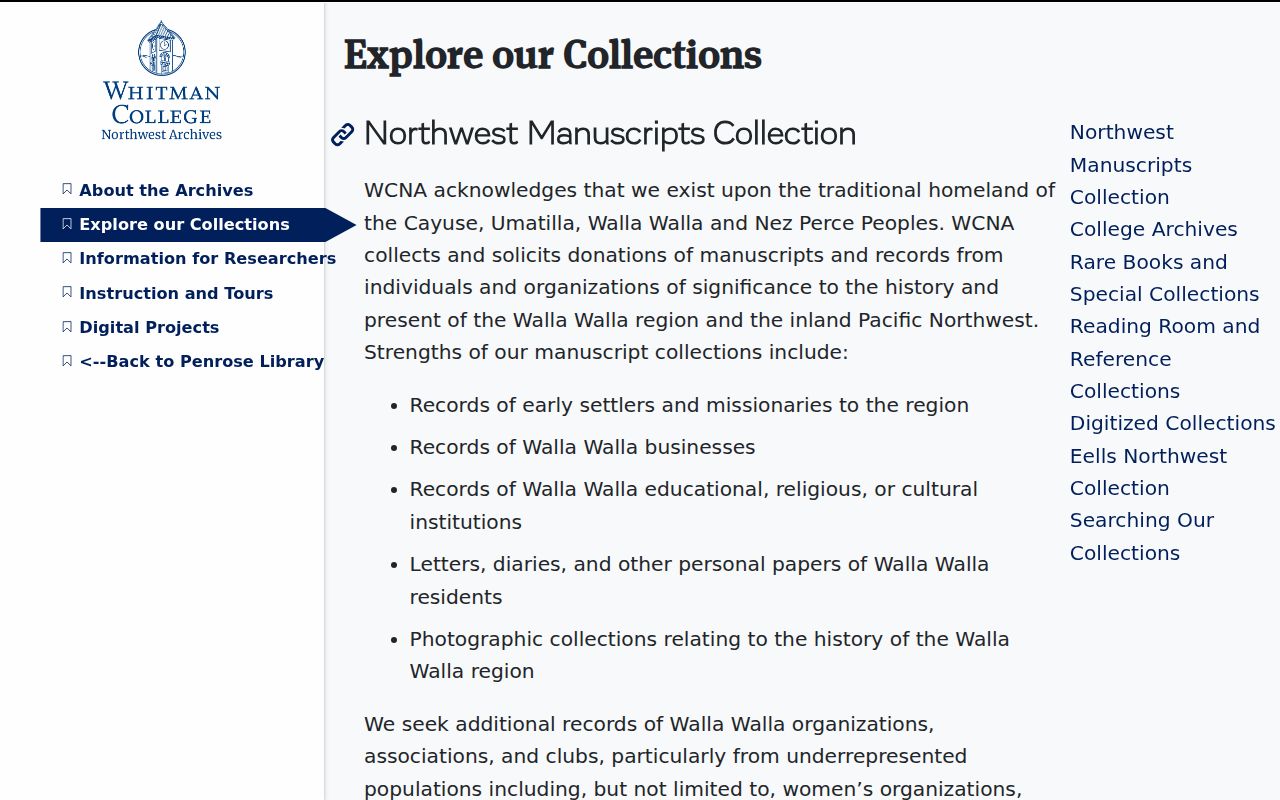
The collection view confirms that directories sit beside newspapers, yearbooks, and manuscripts that can test or deepen a name-and-address lead.
Trace Families in Walla Walla Directories
A dated Walla Walla city directory is most useful as one point in a sequence. Follow changes in spelling, initials, spouse notation, address, and trade. Then compare a directory year with a public federal census. The National Archives explains the 72-year release rule; the 1890 population schedules were largely lost, so directory runs can help span that gap.
- Find the earliest likely surname entry, including initials and alternate spellings.
- Save the volume title, year, page, full line, and abbreviation key.
- Move one available year at a time and log each address or household change.
- Compare the nearest public census household, enumeration place, and age data.
- Test a disappearance with newspapers, Mountain View burial search, probate, or eligible vital records.
A person can vanish because of a move, death, nonpublication, changed spelling, or an unlisted phone. Do not select one reason without a second record. A present-day address search belongs in the Walla Walla street directory, while historical volumes remain the right tool for a dated household.
Walla Walla Directory Newspaper Bridges
Whitman holds Union-Bulletin and predecessor microfilm. Its research page identifies Union-Bulletin digital coverage from 1945 through 2017 for Whitman users; non-affiliates may use microfilm or the paid route named by the archive. No standalone official Walla Walla obituary index was located, so a microfilm holding must not be described as an indexed obituary database.
Search a newspaper by surname, address, business, organization, and a date range shaped by the city directory. Notices can explain a move, marriage, business change, death, or court event. Treat each notice as a clue, then check the cemetery, vital, probate, court, or directory record that fits the claim.
Public Library Genealogy Access
The Walla Walla Public Library identifies HeritageQuest access with a library card and a Pacific Northwest Collection containing early Walla Walla County and Washington books. Its temporary location was 115 W Main Street, 509-527-4550, with published hours Monday through Friday 10 to 7 and Saturday 10 to 3.
The August 3, 2026 renovation notice said the main building at 238 E Alder was under demolition after abatement while service continued downtown. The library was also moving to a new ByWater catalogue and Aspen discovery interface. A title hit does not prove the requested volume is currently accessible, so call the reference desk before relying on a shelf visit.
Note: Record the date when checking hours, catalogue status, and physical access because the renovation makes all three unusually fluid.
Fort Walla Walla Directory Research
The Fort Walla Walla Museum library has a searchable catalogue and public research service. Books do not circulate. Published appointments are Tuesday and Thursday from 11 a.m. to 3 p.m. at 755 NE Myra Road; call 509-525-7703. Members enter free, nonmembers pay museum admission, and research-help fees vary.
This collection is valuable when a city directory name points to military service, farming, wine, a local institution, a neighborhood, a photograph, or a regional artifact. It supplies context rather than a continuous directory run. Ask staff what the catalogue or finding aid holds before planning an appointment.
Open the museum library page before viewing its captured research information.
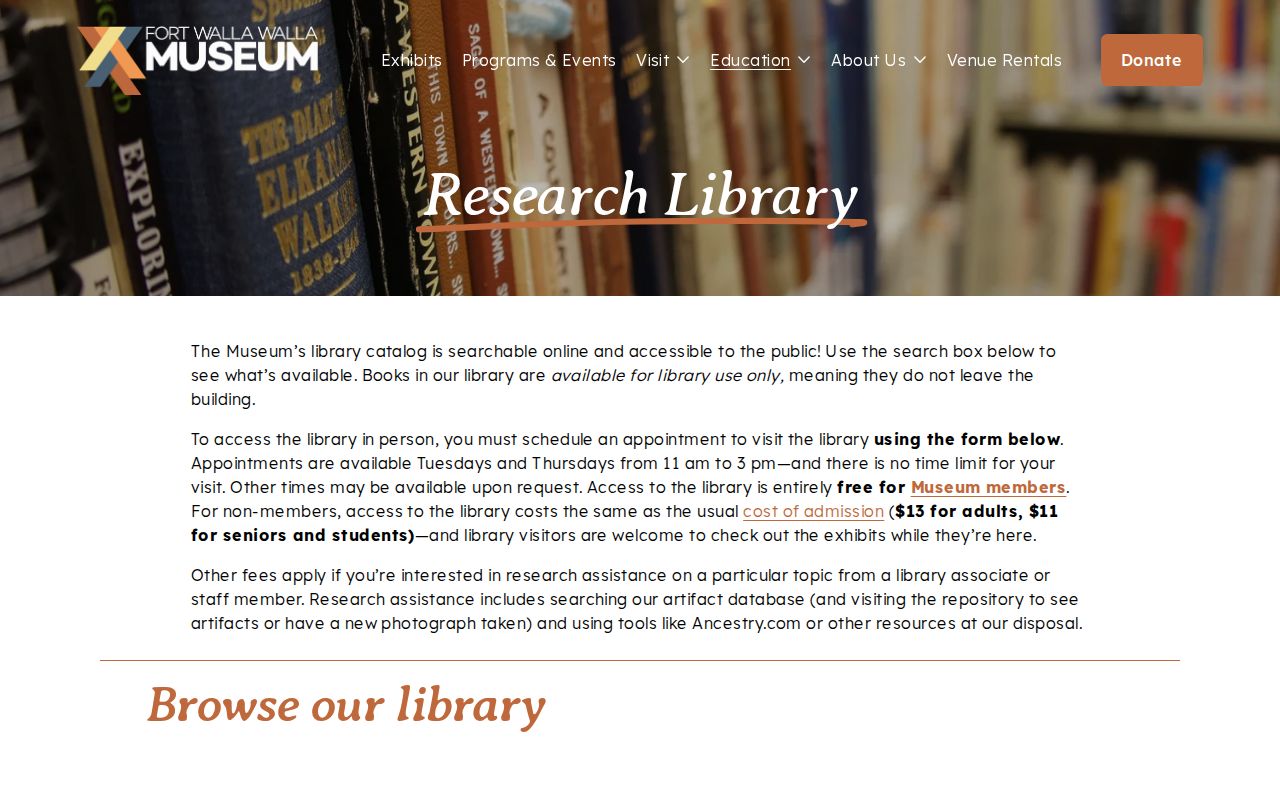
The captured page documents public access, limited appointment times, and the local-history role of this noncirculating collection.
Walla Walla Directory Timeline
The local record trail stretches beyond the printed runs, but each source marks a different moment. The dates below explain how to choose the next shelf.
| Date | Directory or companion source |
|---|---|
| 1854 | Walla Walla County began with boundaries far larger than today's county. |
| 1884 | Three Library of Congress Sanborn sheets show Walla Walla buildings and streets. |
| 1900 | The State Library's listed city-directory runs begin. |
| 1940 | The listed Walla Walla telephone-book holdings begin. |
| 1951 | EagleWeb's modern online recorded-document index begins. |
| 2000 | The listed city-directory holdings end. |
| 2011 | The listed telephone-directory holdings end. |
Historic county labels need care. A territorial-era Walla Walla County record may concern land now outside the present boundary. Pair the event date with a boundary source before rejecting it as the wrong county.
Walla Walla Directory Cemetery Clues
Mountain View Cemetery's burial search can extend a directory trail. Official material describes almost 80 acres, more than 40,000 interments, and an identified 1854 burial. The cemetery consolidates several community traditions, including Masonic, IOOF, Catholic, Chinese, Jewish, veteran, and city histories.
A plot result is an index lead. Pair it with a newspaper notice, eligible certificate, probate file, or dated Walla Walla city directory. Avoid adding unnecessary details about living relatives. The value is the bridge between a last directory appearance and documented family or community history.
Limits of City Directories
Printed city directories never covered everyone. Publication dates may lag collection dates. Some residents were missed, declined a listing, changed names, or lacked telephone service. A trade line or household symbol also depends on that publisher's definitions. Telephone books can be narrower still because unlisted subscribers do not appear.
Separate a directory image from a transcription. Save enough source detail for another researcher to locate the page. When a volume is absent online, use the access chain: Whitman Archives, State Library appointment inquiry, Walla Walla Public Library reference help, Fort Walla Walla Museum, then Washington State Archives or its Eastern Region staff for related records.
Best practice. Cite every Walla Walla city directory entry by title, year, page, exact spelling, repository, and access date, then verify the key fact independently.